INSIGHT
Better Dyeing Is the Wrong Goal
·
To join the conversation, read the article on LinkedIn. Better Dyeing Is the Wrong Goal
There's a question that almost never gets asked in sustainability conversations about fashion, even when the data is right there on the table demanding it.
The question is not "how do we make dyeing better?"
The question is: "Should dyeing — as we currently practice it — exist at all?"
Those are different questions. Entirely different. And the fashion industry has been answering the first one for thirty years while mostly avoiding the second.
What incremental innovation actually does
Every year there are new announcements. A new enzyme process that reduces water use by 30%. A new dyestuff that requires fewer rinse cycles. A new machine that recovers heat from the exhaust stream. Better chemistry, better efficiency, better water management in the waste water treatment plant.
These are real improvements. The engineers and chemists who develop them are doing genuinely important work. And none of it changes the underlying fact: the textile dyeing industry is built on a process that uses enormous volumes of water as a carrier, requires significant energy to heat that water, generates wastewater as an unavoidable byproduct, and creates a supply chain that is fundamentally incompatible with water-stressed geographies and increasingly incompatible with regulatory frameworks.
A 30% improvement on a process that uses 80,000 liters of water per 1,000 kg of yarn still leaves you needing a lot of water and producing a lot of wastewater.
I am not dismissing incremental improvement. I am asking what it is actually in service of. If the goal is to make dyeing more sustainable while keeping dyeing, the incremental path makes sense. If the goal is to fundamentally reduce the industry's impact on water systems and carbon emissions, incremental improvement on the existing process is the wrong frame entirely.
The Kodak problem
Eastman Kodak was excellent at making film. They understood their product deeply, invested heavily in making it better, and held the category with impressive skill for decades. The tragedy was not that they failed to improve film. The tragedy was that they could not hold the idea of a camera without film in the same hand as the idea of their existing business.
The textile industry is facing a version of this right now.
There is a growing body of evidence that the coloration problem — the water, the carbon, the wastewater, the chemistry — can be approached in a fundamentally different way. Not by improving wet processing. By removing the water bath from the equation entirely. By asking: what if color didn't need to be dissolved in water and forced into fiber through heat and chemistry? What if it could be applied directly, mechanically, with precision?
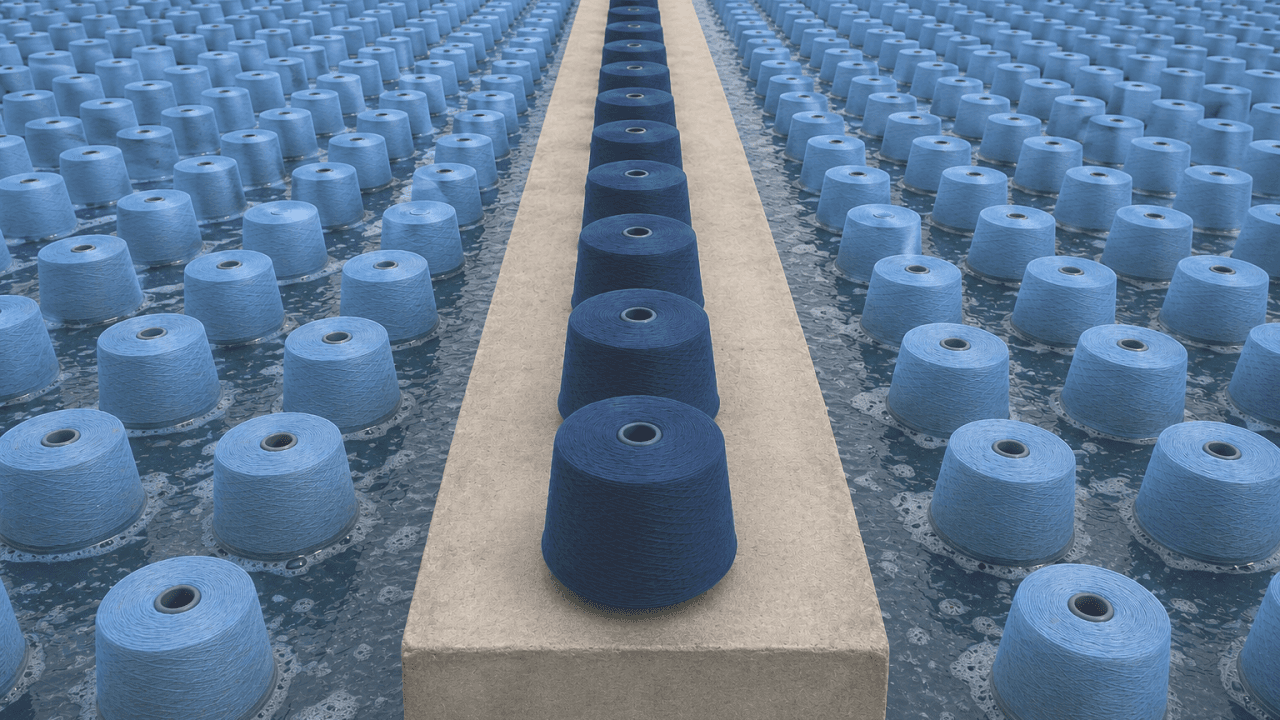
That is not a theoretical question. QuantumCOLOUR™ has been running at industrial scale since 2018. We use approximately 1 litre of water per kilogram of yarn. There is no wastewater. The carbon footprint is roughly 73% lower than conventional fiber reactive yarn dyeing. The technology is fiber-agnostic — it works on cotton, wool, synthetics, recycled content, and blends in a single pass.
I am sharing these numbers not to make a sales argument. I am sharing them because they illustrate what becomes possible when the question changes.
What the adoption data tells us
One of the most important reports on textile innovation published in the last few years is the Transformers Foundation “Unlocking Equity in Innovation” from January 2026. It examines why technologies that demonstrably work fail to reach commercial scale. The findings are not flattering to the industry.
The barriers are not technical. By the time a technology has been running at industrial scale for several years, the technical questions are largely answered. The barriers are structural: misaligned incentives between sustainability teams and sourcing teams, brand champions who move on before they can follow through, supplier investment risk that falls on mills rather than brands, and a deep institutional preference for "safe" incremental choices over transformative ones.
The report describes this as brands choosing drop-in solutions that preserve the underlying process architecture. That phrase stuck with me.
Because that is exactly what most of the sustainability investments in dyeing are doing. Improving within the architecture. Making the existing system cleaner, more efficient, less damaging at the margins. While the architecture of the problem — water as carrier, chemistry as forcing agent, wastewater as byproduct — stays intact.
The cost of the question not being asked
There is a practical consequence to framing the question wrong.
If the industry collectively decides that the goal is "better dyeing," it will continue to invest in better dyeing. Standards will be written around better dyeing. Certification schemes will reward better dyeing. Supplier scorecards will measure improvements to the dyeing process. And technologies that step outside that frame will continue to face the structural barriers the Transformers Foundation describes: misalignment, lack of champions, reluctance to commit capital to something that doesn't fit the existing system.
The data on industry emissions does not support the conclusion that better dyeing is working fast enough. The Apparel Impact Institute's 2025 benchmark reported that sector emissions increased 7.5% in 2023 — the first year-on-year increase since tracking began. That is not a measurement of individual company progress. It is a measurement of the aggregate result of the industry's choices.
The planet does not grade on a curve for effort.
Holding both things at once
I want to be precise about something.
I am not arguing that conventional dyeing has no place. I am not suggesting that every mill should throw out its existing infrastructure tomorrow. And I am genuinely respectful of the craft and expertise that has built the textile dyeing industry into what it is.
What I am suggesting is that the industry needs to be able to hold two things at once: the reality of what exists today and the honest question of what needs to exist in ten years. And that those two things are not the same.
Buckminster Fuller wrote: "You never change things by fighting the existing reality. To change something, build a new model that makes the existing model obsolete."
We didn't set out to improve dyeing. We set out to make it irrelevant.
Those are different goals. And only one of them is equal to the scale of the problem.
Jennifer Thompson is CEO and Co-Founder of COLOURizd LLC, developer of QuantumCOLOUR™, a precision yarn coloration system that delivers pigment to fibre surfaces within the yarn bundle via robotics — no dye bath, no wastewater discharge, verified 73% CO₂ reduction, ~99% water reduction. Industrial scale since 2018.
Data sources: COLOURizd Yarn Cost Calculator; Peterson Projects & Solutions LCA, ISO 14067:2018, January 2021; Apparel Impact Institute, Taking Stock 2025; Transformers Foundation Unlocking Equity in Innovation Jan 2026.
#TextileInnovation #SustainableTextiles #COLOURizd #QuantumCOLOUR #RadicalInnovation #CircularFashion #Decarbonization #WaterStewardship
