
INSIGHT
We Have Preferred Materials. Where's Preferred Processing?
·
To join the conversation, read the full article on LinkedIn. We Have Preferred Materials. Where's Preferred Processing?
The apparel industry just got its report card, and it's not good. According to the Apparel Impact Institute's latest Taking Stock report, our sector's emissions didn't fall last year. They rose — 7.5%, to 944 million tonnes of CO2e.
Let that sink in for a minute. We have had preferred materials programs for two decades. Nearly every major brand has a preferred fibre policy, a sustainable cotton commitment, a recycled polyester target. The reporting is mature, the certifications are established, the data is good.
And emissions went up.
So I want to ask an uncomfortable question: what if we've been looking in the wrong direction?
The chart everyone shares and nobody acts on
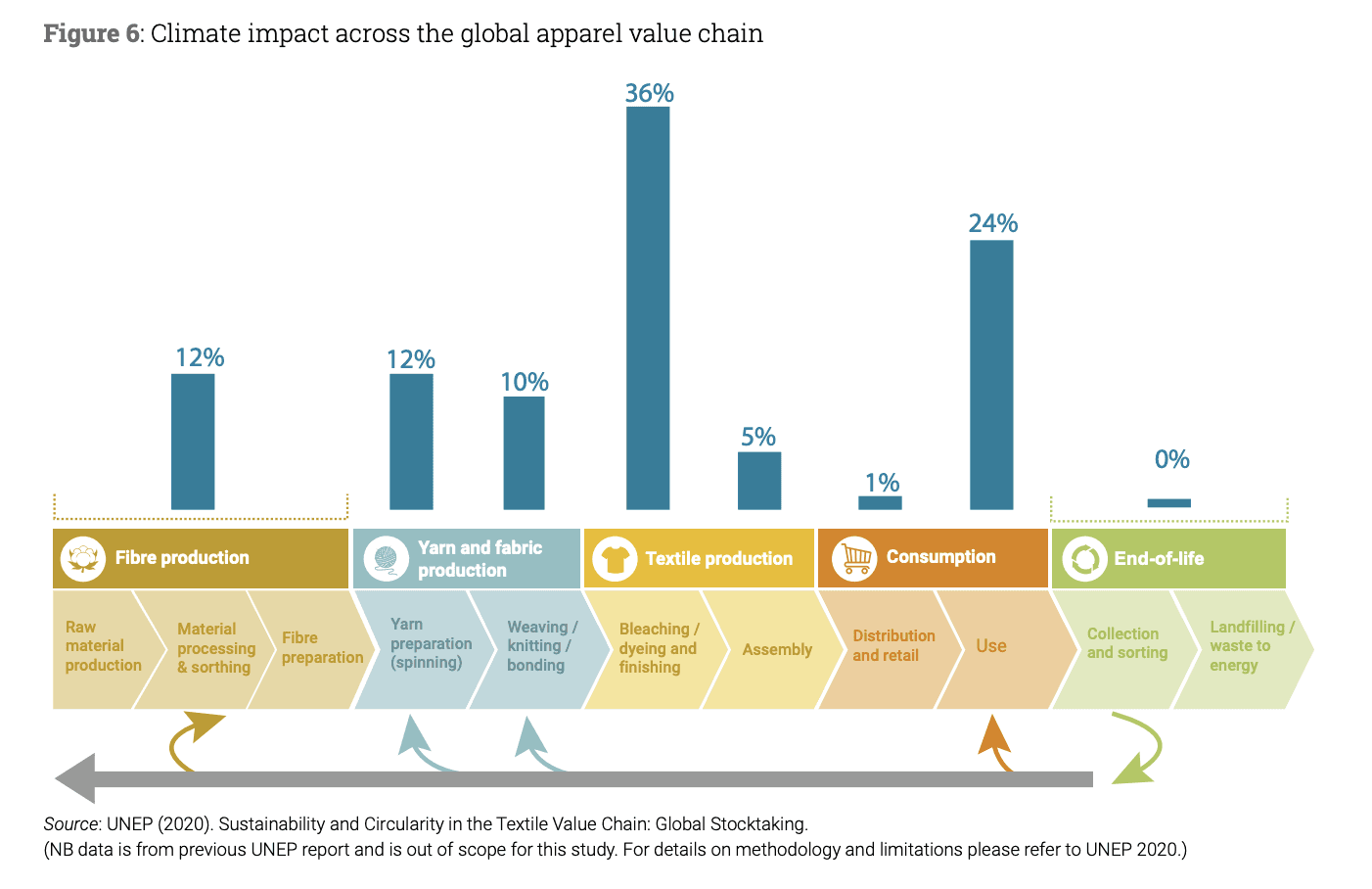
Back in 2018, Quantis published Measuring Fashion, one of the most cited studies on where a garment's climate impact actually comes from. Here's the breakdown of apparel production emissions:
Fibre production: 15%
Yarn preparation: 28%
Dyeing and finishing: 36%
Fabric preparation: 12%
Assembly: 7%
Read that again. Fibre — the thing we've built our entire industry sustainability apparatus around — is 15% of a garment's production footprint. Dyeing and finishing alone is 36%. More than double. And if you add up everything that happens between the fibre and the sewing floor — spinning, fabric prep, dyeing, finishing — processing is over three-quarters of the total.
And here's the thing I say in meetings all the time, usually to a few laughs: no matter what we do, there is always going to be fibre in the garment. We can improve that 15%, but we can never take it to zero. We're not producing the Emperor's new clothes, and I don't see walking around naked trending anytime soon. Fibre has a floor. Processing doesn't. A dye bath can be reinvented. An industrial wash cycle can disappear entirely. The big number is also the most moveable one.
This isn't one study's opinion, either. The WRI and Aii Roadmap to Net Zero puts Tier 2 at 52% of the industry's supply chain emissions — and don't let their label fool you: "Tier 2 material production" in their model means the textile mills, where yarn becomes fabric and fabric gets dyed and finished. Fibre sits further upstream, in Tiers 3 and 4. Aii's 2025 update puts textile processing at 55%. Even McKinsey's Fashion on Climate, which draws its boundaries differently and gives materials a bigger share, concludes that the single largest abatement opportunity in fashion is decarbonizing processing — the boilers, the dye houses, the energy.
Three major studies. Different methods, different boundaries. Same answer: the biggest lever is processing.
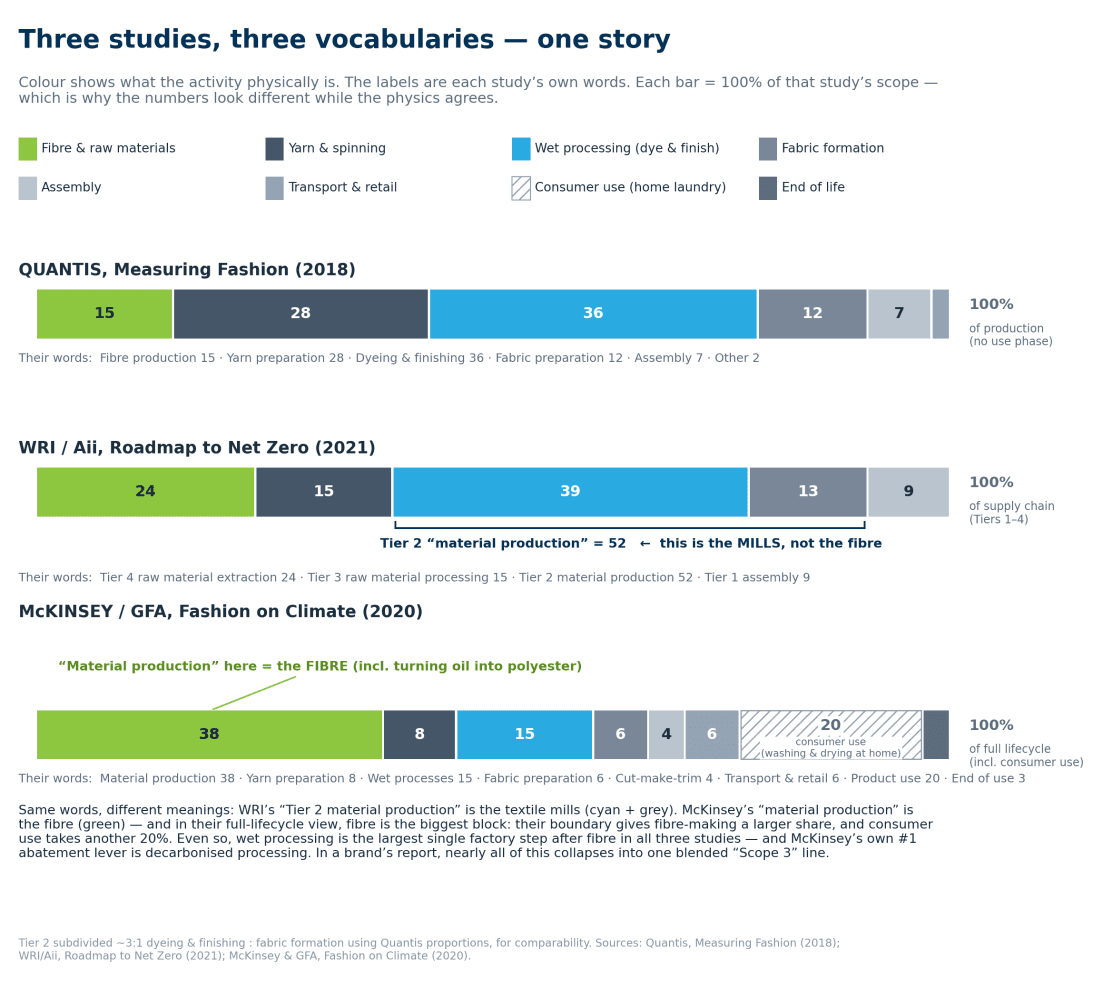
To be fair about scope: these percentages cover production — they don't include what happens after purchase, when consumers wash and dry their clothes. But production is exactly the part our supply chain programs can control. That's where our policies point. Or where they should point.
So why does every brand have a materials plan while very few have a processing plan?
I don't think anyone actually did the math and chose fibre. I think it's because fibre was easy to act on.
Organizations like Textile Exchange did genuinely important work making fibre data accessible, comparable, and certifiable. A brand could sit at the design desk, swap conventional cotton for a preferred version, count it, certify it, and report it. Clean story. Third-party backing. Done.
Wet processing has none of that. It's fragmented across thousands of mills. Every facility is different — I recently walked a finishing operation in Italy, and I have never seen so many different machines in one building in my life. Every recipe creates a different impact. It sits two or three tiers deep in the supply chain, where most brands have never set foot.
And here's the thing: there's no wet processing champion. No organization whose whole job is to say, "If you're serious about your 2030 targets, this is where the tonnes are."
So we measured what was easy instead of what was big.
What actually happens when you change processing
Let me make this concrete, because I'm fortunate enough to sit on real data here. My company works in yarn coloration — squarely inside that 36% slice — so we've had to prove these numbers out.
Start with the math anyone can do. Switch a garment to a preferred fibre that's 30–50% cleaner, and you save roughly 5–8 points of that garment's production footprint. That's real, and worth doing.
Now change the coloration process instead. A third-party LCA of our system — verified to ISO 14067:2018 — measured up to a 73% reduction in the carbon footprint of yarn coloration compared to conventional dyeing. And let's be careful with the math here, because "dyeing and finishing" is one slice of the chart and coloration is only part of it. Using industry benchmark data for denim — chosen on purpose, because denim carries the heaviest finishing load of any garment category, which makes this the conservative case — dyeing is roughly two-thirds of that piece; finishing is the rest. And finishing doesn't disappear — it simplifies. Cut the coloration piece by 73%, simplify the downstream wash the way cleanly coloured yarn allows (about a third less impact, per benchmark data and a partner mill study), and that whole piece shrinks from 36 points to about 15. The garment's total production footprint drops by roughly 21%. From one process change. Three to four times the impact of converting the entire garment to preferred fibre. And remember, that's the denim-based worst case — for products with lighter finishing, coloration is a bigger share of the slice, and the reduction only gets larger.
If you're a brand staring at a gap-to-2030 chart, that's the difference between a rounding error and real progress. And if you're a mill wondering what wins the next brand conversation — it's being the one that can close that gap.
And with denim, it goes further, because coloration choices cascade downstream. When you colour yarn cleanly at the start, you don't have to bleach and blast the colour back out at the end. In an independent LCA conducted with a major global retailer, our process reduced the impact of a pair of jeans by roughly 60%. In a separate mill study, garment washes for light and medium shades dropped from an environmental impact (Jeanologia’s EIM) score of 43 to 9 — a 79% reduction — because the laundry no longer needed stone washing, double bleaching, and and long washing to get there. Dark shades? Honestly, about even. The gains come from everything you no longer have to undo.
That's the part I think we keep missing. Processing impacts multiply through the value chain. Fibre impacts mostly don't.
One more thing, and it matters: the cleaner wash route in that mill study also cost 44% less per garment. I get asked about sustainability and cost all the time, and my answer is always the same — if something is truly sustainable, in the long run it should cost less. But that's the next article.
This is an "and," not an "instead"
I want to be careful here, because I can already hear the objection. Preferred materials policies are not wrong. Fibre choices drive land use, biodiversity, water at the farm level, microplastics. Materials genuinely matter, and the people who built those programs built something valuable.
And here's the good news: you don't have to choose. Stack them. A preferred fibre takes about 6 points off a garment's production footprint. Preferred processing takes off about 21. Do both, and you're down 27% — from the two decisions a brand already knows how to make.
(And a note for the people who like to check the math, because I do too: those stage percentages are shares of a whole. Shrink the biggest piece and the others grow as a share of what's left — in the stacked scenario, yarn preparation becomes about 38% of the remaining footprint. Which tells you exactly where this industry conversation needs to go next.)
But a materials policy alone is not a carbon plan. The carbon is in the boilers, the dye baths, the dryers, the wash cycles. And you can't get there by changing the light bulbs or buying a slightly better boiler. At some point, if we want 2030 targets — which are quietly becoming 2040 targets — we have to be willing to get rid of the boiler.
What a preferred processing policy would look like
So here's my proposal, and brands can steal it freely.
Every brand with a preferred materials policy should have a preferred processing policy — same rigor, same reporting, same shelf space in the sustainability report. It would mean knowing the processing footprint of your top products, not just their fibre content. Setting processing-specific targets instead of letting wet processing hide inside a blended Scope 3 number. And building actual commitments with the mills and technologies that can deliver step-change reductions — not 10% efficiency gains, but the 50–70% reductions the data says are sitting right there in the biggest piece of the chart.
The technologies exist. The economics work — this is one of the rare corners of sustainability where the cleaner path is also the cheaper one. What's missing is the focus.
We've spent twenty years optimizing 15% of the problem. The 944-million-tonne question is: who's ready to work on the 36%?
So let me ask it straight — does your brand have a wet processing plan? And if not... why not?
Sources referenced
Quantis, Measuring Fashion (2018) — production-stage climate breakdown
Apparel Impact Institute, Taking Stock of Progress Against the Roadmap to Net Zero (July 2025) — 944 Mt, +7.5%, processing = 55%
WRI / Aii, Roadmap to Net Zero (2021) — Tier 2 = 52% of supply chain emissions
McKinsey / GFA, Fashion on Climate (2020) — materials 38% under lifecycle boundaries; processing = largest abatement lever
Partner mill wash study (EIM 43→9, cost −44%); third-party retailer LCA (~60% per pair of jeans); COLOURizd third-party coloration LCA (−73%)
